
Should I Refinance My Car Loan? Cancel These First
Refinancing a car loan saved the average borrower $83 a month in 2026. Before you apply, cancel the add-ons you can still get refunded, because the refund lowers the balance you refinance. The order of operations, the timing, and what happens to GAP.
Miles
DealPrepare's car buying consultant
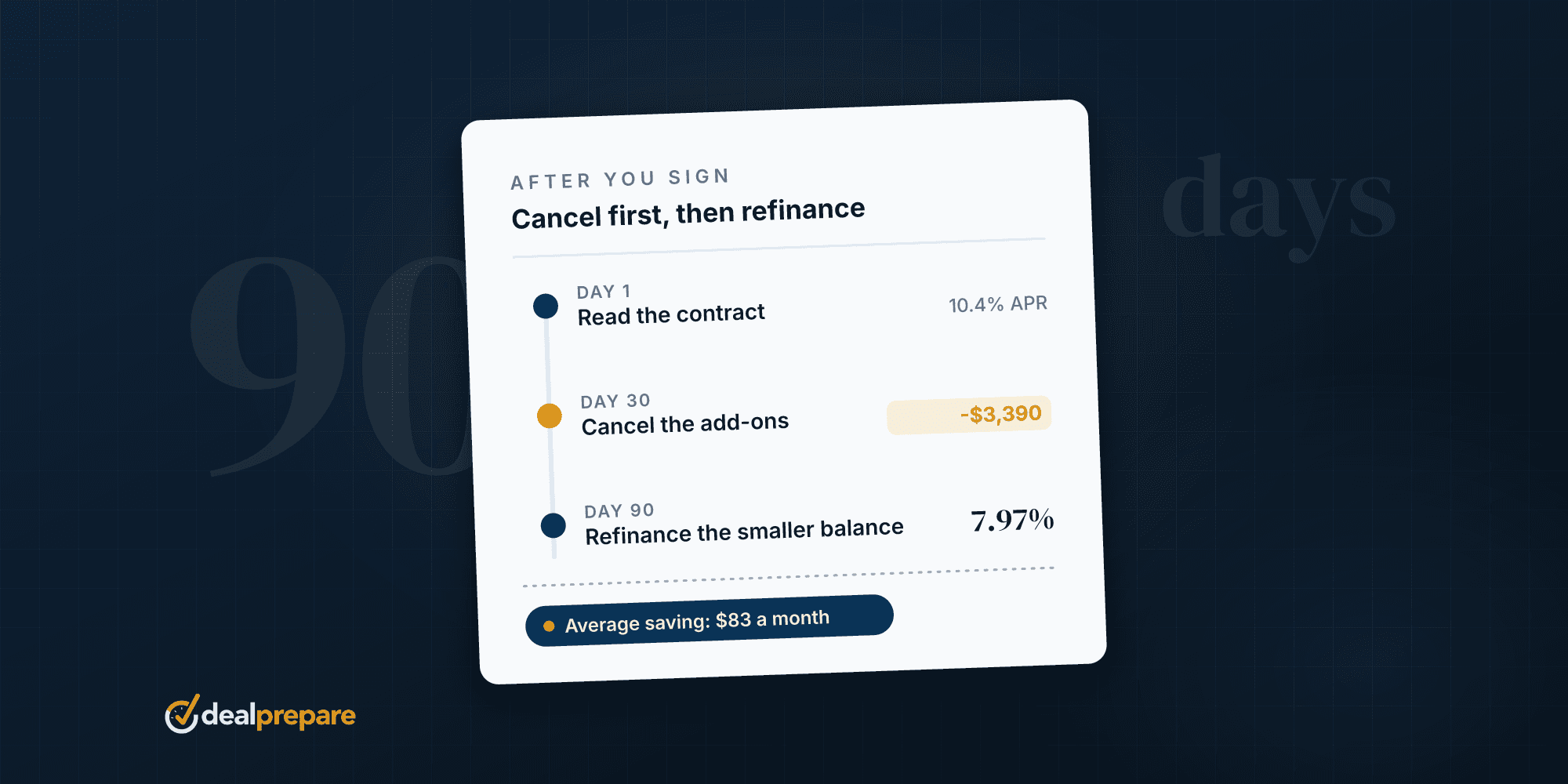
The rate on your contract is higher than the rates you keep seeing advertised, and someone, maybe the salesperson, told you not to worry because you can always refinance. The second half of that is true. Here is the part nobody adds: the order you do things in decides how much the refinance is worth, and the first move is not applying for a loan. It is cancelling what you can still get refunded on the loan you have.
The short answer
Refinance when a credit union or bank will beat your contract rate by more than a point, you are in the first year or two of the loan, and your contract has no prepayment penalty. Most lenders want the title settled first, which takes 60 to 90 days. Use that wait. The service contract, GAP and tire and wheel plan the finance office added can usually be cancelled in full during roughly the same window, and every dollar refunded comes off the balance you are about to refinance.
What refinancing is doing for people right now
Refinancing has roughly doubled in two years. Experian counted about 140,000 auto loans refinanced in the second quarter of 2026. The average loan went from 10.40% to 7.97%, saved $83 a month, and was refinanced about 26 months after it was signed. Where the new loan came from mattered: credit unions cut the payment by $102 a month on average, banks by $65, finance companies by $38.
Source: Experian, State of the Automotive Finance Market, Q2 2026, as reported on Experian's insights blog and in trade coverage. The figures move each quarter; the pattern does not.
Two things to take from that. Refinance rates fell faster than purchase rates after the Fed began cutting, so the gap between a dealer-arranged rate and a credit union's is wider than usual. And 26 months is a long time to pay a rate you did not need to pay. People who start at 90 days do better.
First, is your rate actually high?
Before you spend an afternoon on applications, check the rate against your credit. A dealer-arranged rate is the lender's approved rate plus whatever the dealer added, and the only way to see it is to compare. The rate check page has the current average APR by credit tier for new and used cars, from the same Experian report. Find your tier, compare it with the APR on your contract. A rate more than a point over the average for your tier is worth refinancing. A rate at or under it usually is not, unless your credit has improved since you signed.
For how the table reads and what a marked-up rate looks like, see what is a good APR for a car loan.
The 90-day order of operations
Week one: read the contract, not the payment
Three things to find on the retail installment contract.
- The amount financed and what is in it. Look for a service contract, GAP, tire and wheel, paint or fabric protection, prepaid maintenance, credit life or disability insurance. On many contracts these add $2,000 to $5,000 to the balance. They are the money.
- The interest method. "Simple interest" is normal. "Precomputed interest" or a "Rule of 78" clause means interest is front-loaded and an early payoff saves less than you expect. Federal law bars the Rule of 78 on loans longer than about five years, and some states ban it outright, but it still appears on shorter loans.
- A prepayment penalty. Many states allow one on auto loans, typically around 2% of the balance where it exists. A refinance is a prepayment, so the penalty applies. Ask the lender for a written payoff quote that shows it.
Weeks one to eight: cancel what can be cancelled
A service contract, GAP waiver or tire and wheel plan can usually be cancelled for a full refund inside a free-look window, often the first 30 to 60 days, and prorated minus a small fee after that. Credit life or disability insurance refunds the unearned premium under state insurance law. Prepaid maintenance depends on its contract and the visits used. Coatings, etching, nitrogen, window tint and theft trackers are products already applied to the car, and they are not refundable once installed.
Two facts about where the money goes. When the product was financed into the loan, the refund goes to the lender and comes off the loan balance; your payment stays the same and the loan ends sooner. And nothing cancels itself: a refinance does not cancel a service contract, and GAP ends with the loan but the refund still has to be asked for. Each cancellation is a short written notice to whoever the contract names, with the contract number, the date and the odometer reading. How cancelling works, with a letter you can copy.
Why this comes before the refinance: the refund lands on the old loan's balance in a few weeks, so the payoff the new lender sees is smaller. Say the finance office added a $2,495 service contract and an $895 GAP waiver and you cancel both in the free look. That is $3,390 off the payoff. On a 72-month refinance at 8%, $3,390 of balance is about $60 a month. If you were upside down, that is also the difference between a refinance lender saying yes and saying the car does not cover the loan.
Days 60 to 90: apply, starting with a credit union
Once the title has settled, get a payoff quote from your current lender and apply with two or three lenders inside a two-week window so the inquiries count as one. Credit unions saved borrowers the most in Experian's data and are usually the easiest to join. Compare each offer on the rate, the term and the total you would pay over the life of the loan. A lower payment on a longer term can cost more in total; the point is a lower rate on the same remaining term, or shorter.
Lenders also check the car: most want it under a certain age and mileage, and the loan balance above a floor. If the car is old or the balance is small, a refinance may not be offered, and paying extra toward principal does the same work.
What happens to GAP when you refinance
GAP protects one loan. The refinance pays that loan off, so the GAP ends, and the unused part is usually owed back to you prorated. It is rarely automatic. Contact whoever the GAP contract names, usually the administrator or the dealer's finance office, with the payoff date, and ask for the refund in writing.
The new loan has no GAP unless its paperwork says so. If the car is worth less than the new balance, you still want it. Buy it from your own auto insurer, which typically adds a small amount to the premium, rather than through the new lender's menu. What ends with the loan, and how to claim it.
If you are upside down
Owing more than the car is worth makes refinancing hardest, which is also where the order of operations matters most. The cancellations come off the balance. A few months of payments bring it down further. Many lenders will refinance up to a certain share of the car's value, and a balance that was 20% over may be inside the line by the time the title settles. If it is still outside, keep paying it down, and revisit at six months when more lenders will look.
What you need to apply
- The payoff quote from your current lender, in writing, dated.
- The contract, so the new lender can see the rate, the term and the amount financed.
- Proof of income and your driver's license.
- The car's VIN and current mileage; the lender will check its value.
- Your cancellation confirmations, so the payoff reflects the refunds.
Where to start
If you signed in the last 90 days, the fastest first step is to see what is still cancellable on your own paperwork. Upload the contract and Miles lists each add-on that can still be cancelled, the window you are in and a ballpark refund, then you know what to cancel before you apply. It is free and needs no card. Upload the signed paperwork.
If you have not signed yet, the cheaper fix is to not need this article. Get a pre-approval before you go in, and have the dealer's quote read line by line before you sign it: scan your quote free.
Frequently asked questions
- How soon can you refinance a car loan after buying?
- Usually once the title and the loan paperwork have settled, about 60 to 90 days after the purchase. Some lenders have no waiting rule, several large banks want the loan open six months, and many set a minimum balance, often $7,500 or more. The wait is useful: it is the same window in which most service contracts and GAP can still be cancelled for a full refund.
- Is it worth refinancing a car loan?
- It is worth it when a new lender's rate is more than a point below the rate on your contract, you are early in the loan, and the contract has no prepayment penalty or precomputed interest. In the second quarter of 2026 the average refinance took a loan from 10.40% to 7.97% and saved $83 a month, with credit unions saving the most. Compare the total you still owe under each loan, not just the payment.
- What happens to GAP insurance when you refinance?
- GAP protects one specific loan, so it ends when the refinance pays that loan off. The unused part is usually owed back to you on a prorated basis, but it is rarely refunded automatically: you ask whoever the GAP contract names, with the payoff date. The new loan has no GAP unless its paperwork says so, so if you still owe more than the car is worth, buy it from your own insurer, which usually costs far less than the finance office charged.
- Does an extended warranty transfer when you refinance?
- The service contract stays with the car and the contract holder, not the loan, so it keeps running after a refinance. If you want out of it, you cancel it yourself in writing. Inside the free-look window, often the first 30 to 60 days, the refund is in full; after that it is prorated minus a fee. When the contract was financed, the refund goes to the lender that financed it and lowers that balance.
- Does refinancing a car loan hurt your credit?
- Applying adds a hard inquiry, which costs a few points for a few months. Rate-shopping inquiries for the same kind of loan inside a short window are usually counted as one. The new loan also resets the account's age. For most people the saving outweighs the dip, and on-time payments on the new loan rebuild it.
Put this advice to work
Upload your dealer quote and Miles will flag the markups, the fees that shouldn't be there, and the add-ons before you sign anything.
Scan your quote freeNo quote yet? Check the market price free
Not sure where to start? Talk it through with Miles, free