
What Is a Good APR for a Car Loan? 2026 Rates by Credit Score
A good car loan APR in 2026 is at or below the average for your credit tier: about 4.4% with excellent credit on a new car, 6% to 7% with good credit, 10% or more with fair credit. Here is the full table, what a dealer markup looks like, and how to tell if your quoted rate is one.
Miles
Former dealer insider
Someone posts their finance office paperwork and asks: "Is 7.9% good?" And the honest answer is that it depends on four things nobody mentioned. Your credit score. Whether the car is new or used. The length of the loan. And whether 7.9% is the rate the lender approved you at, or the rate the dealer decided to show you.
Here are the actual numbers, then how to tell which of those two rates you are looking at.
The Short Answer
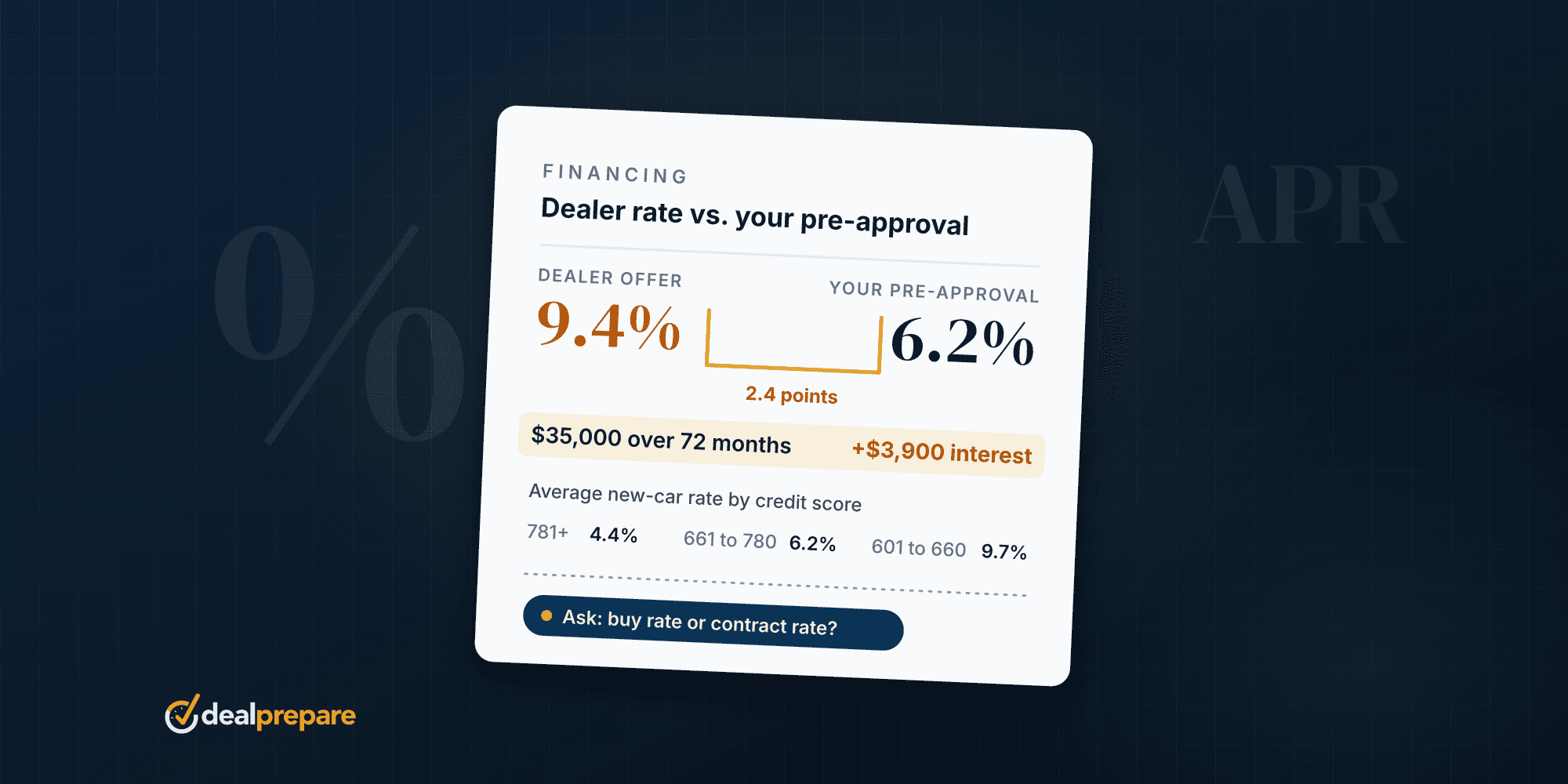
A good APR is at or below the average for your credit tier. Those averages, from Experian's most recent quarterly report on auto financing:
| Credit tier | Score range | New car | Used car |
|---|---|---|---|
| Super prime | 781 to 850 | 4.41% | 6.29% |
| Prime | 661 to 780 | 6.15% | 8.81% |
| Near prime | 601 to 660 | 9.71% | 13.93% |
| Subprime | 501 to 600 | 13.52% | 19.10% |
| Deep subprime | 300 to 500 | 16.11% | 21.62% |
Source: Experian State of the Automotive Finance Market, Q2 2026, VantageScore 4.0. Averages shift a few tenths each quarter; the gaps between tiers do not.
Two things to keep in mind. These are averages, not floors. Credit unions routinely beat them by a point or more for the same borrower. And manufacturer financing sometimes offers promotional rates well below any of these on specific models, usually in place of a cash rebate rather than in addition to it.
Why "Good" Is Different for Used Cars
Every tier pays more to finance a used car. The vehicle is older, worth less as collateral, and more likely to be worth less than the loan balance for longer. So a 9% rate on a used car with prime credit is roughly average. The same 9% on a new car with the same credit is two to three points over average, and that gap has a name in the finance office. It is called reserve.
What a Point Actually Costs
The difference between two rates sounds small until it is stretched over a loan term. Take $35,000 financed for 72 months:
| APR | Monthly payment | Total interest |
|---|---|---|
| 6.0% | $580 | $6,760 |
| 8.0% | $614 | $9,190 |
Two points is about $34 a month, which is easy to wave off, and about $2,400 over the life of the loan, which is not. On the quote, a marked-up rate looks like a slightly higher payment. In your bank account it looks like a used-car down payment you never made.
How Dealer APR Markup Works
When a dealer submits your application, the lender comes back with a buy rate, the rate they will actually accept. The dealer is allowed to write your contract at a higher rate and keep a share of the difference over the life of the loan. That share is the finance reserve, and it is one of the largest profit centers in the building. Most lenders cap the markup at one to two and a half points, and some have moved to flat fees under regulatory pressure, but the practice is legal and it is not disclosed on any document you sign.
What makes it hard to see is that the finance office rarely quotes a rate at all. It quotes a payment. "We got you to $614 a month." The rate behind that payment, and the term that was stretched to keep the payment where you wanted it, take a question to surface.
How to Tell If Your Quoted APR Is Marked Up
Get a pre-approval first. A credit union, your bank, or an online lender will give you a rate before you shop. That number is the only benchmark that accounts for your actual credit file, and it turns the finance office conversation from "what can you get me" into "can you beat this."
Ask one question. "Is that the buy rate or the contract rate?" A finance manager knows exactly what you are asking. The answer, or the pause before it, tells you what you need.
Check the tier table. With a 760 score and a new car, a quote at 9% is not your credit. It is somebody's reserve.
Look at the term. A longer loan can hide a higher rate behind a similar payment. Compare rate to rate, at the same term, never payment to payment.
Be suspicious of "we could only get you approved at." With a score above 660 and a normal debt load, that sentence is almost never true. It is an opening offer.
0% APR or the Rebate?
When a manufacturer offers a choice between promotional financing and a cash rebate, take the rebate if the interest you would pay at your pre-approved rate is less than the rebate amount. On $30,000 over 60 months, 5.5% costs about $4,370 in interest. A $2,500 rebate loses to the 0% offer. A $5,000 rebate beats it. Run the math with your own rate, not the dealer's standard rate.
If Your Credit Is Fair or Worse
Be realistic about the tier you are in, and then refuse the two things that make a high rate ruinous. Do not take an 84-month term to get the payment down; it puts you underwater for most of the loan. And do not accept the first "we found you something" rate. Get a pre-approval even if the rate is high, because it caps what the dealer can add. Then plan to refinance after twelve months of on-time payments, which is when most lenders will look at you again.
Bring the Number to the Table
The script is short. "I'm pre-approved at 6.2%. If you can beat it, I'll finance with you." Dealers frequently can, because a smaller slice of reserve is better than none, and now the rate is competing against a real alternative instead of against your patience. Everything else that happens in that room is covered in what happens in the finance office, and the rest of the deal is covered in our negotiation playbook.
Let Miles Check the Rate
Add your pre-approved rate to your buyer profile, then upload the quote. Miles compares the dealer's APR to your own rate, prices the difference in dollars over the actual term of the loan, and flags a quote that shows a payment with no rate behind it. A rate is either at or below your benchmark, or it is a number you are being asked to pay for. Miles tells you which.
Frequently asked questions
- Is 7% a good APR for a car loan?
- For a new car with a credit score in the 661 to 780 range, 7% is slightly above the mid-2026 average of about 6.2%, so it is acceptable but beatable, usually by a credit union. For a used car with the same credit, 7% is a strong rate. With a score above 780, 7% on a new car is a sign the rate has been marked up.
- Is 10% APR high for a car loan?
- It depends on your credit. With a score above 660 it is high for a new car and worth shopping against a credit union before you sign. With a score between 601 and 660 it is close to the average for a new car and below average for a used one. Above 12% on any car, ask the finance manager directly whether that is the lender's rate or the dealer's rate after markup.
- What APR should I get with a 750 credit score?
- A 750 score sits in the prime tier, where new car loans averaged about 6.2% and used car loans about 8.8% in mid-2026. A credit union will often go a point or more below that. If a dealer quotes you 9% or higher with a 750 score, something other than your credit is setting the rate.
- Can a dealer mark up your interest rate?
- Yes, and it is legal. The lender approves you at a buy rate, the dealer is allowed to present a higher contract rate, and the dealer keeps a share of the difference. Most lenders cap the markup at one to two and a half points. The only reliable way to see it is to walk in with a pre-approval and compare.
- What is a good APR for a used car?
- Used car rates run two to five points above new car rates at every credit tier because the collateral is older. In mid-2026 that meant roughly 6.3% with excellent credit, 8.8% with good credit, and 14% with fair credit. Anything at or under those figures is a good used car rate.
Put this advice to work
Upload your dealer quote and Miles will flag the markups, junk fees, and add-ons before you sign anything.
Scan your quote free