
Should You Pay a Car Broker, or Can AI Help You Buy a Car?
A car broker sells two things: knowledge of what a deal should look like, and someone to negotiate it. AI grounded in live market data now gives you the first for a fraction of a broker's fee. Here is what each one does, what each costs, and when a broker is still worth it.
Miles
Former dealer insider
More people than ever want to buy a car without the dealership experience. No four hours in a showroom. No manager walking over with a number on a sheet. The pitch from car brokers speaks straight to that: pay a fee, skip the haggle, get a better deal.
For some buyers that is exactly the right call. For most, it helps to see what a broker actually sells, because there are now two ways to get the same advantage, and one of them costs less than a tank of gas.
What a Car Broker Actually Does
A car broker works on your behalf to find the car and negotiate the price. A good one knows the market, knows which dealers move inventory, and knows what a clean deal looks like. Depending on the broker, the service can include:
- Sourcing the exact car, including hard-to-find trims and colors
- Negotiating the price, and sometimes the trade-in
- Handling the paperwork and arranging delivery
Most brokers charge a flat fee, commonly somewhere between a few hundred dollars and $1,000, and more for luxury or hard-to-find vehicles. Some take a retainer up front or a share of the savings instead. One question to always ask: is the broker also paid by the dealer? A broker who collects from both sides has a reason to close a deal, not necessarily your best one.
What You Are Really Paying For
Strip it down and a broker sells two things.
Knowledge. What this exact car sells for near you. Which fees are normal in your state and which are padding. Which add-ons are worth declining. What interest rate your credit should get. How dealers move numbers between price, trade, and financing to make a deal look better than it is.
Labor. Someone else makes the calls, handles the back-and-forth, and sits through the process.
The labor is real, and some people should pay for it. But the knowledge is what actually changes the price. And the knowledge no longer requires a broker.
Can AI Help You Buy a Car?
Yes, with one condition: it has to work from real data. Car prices move every week. An AI that answers from memory is guessing, however confident it sounds. An AI that researches the live market for your exact car and reads the dealer's actual paperwork is doing what a broker's experience does, in about a minute.
That is how Miles works:
- The market price. Miles searches live listings and value guides for the exact year, trim, and mileage near your ZIP, and shows the typical price, the range, and the listings he used. You can run a free market check right now, no account needed.
- The whole quote. When the dealer sends numbers, scan the quote, as a PDF, a photo, or even a handwritten worksheet. Miles checks every fee against your state's typical charges, every add-on against real benchmarks, and the rate against your own pre-approval or credit tier, next to the live market price.
- The words to say. Every flagged line comes with what to say back to the dealer, and you can ask Miles anything about your deal.
- Before there is a quote. Prepare with Miles keeps your cars, your trade-in, your budget, and your priorities in one place. Miles helps you set a target price and keeps you on track until the dealer puts a quote in writing.
What Miles does not do is sit in the showroom for you. He does not see or drive the car, which is why a history report and, for a used car, an inspection still matter. And he does not make the call to the dealer. You do, with the same numbers a broker would bring.
Two Things You Don't Buy a Car Without
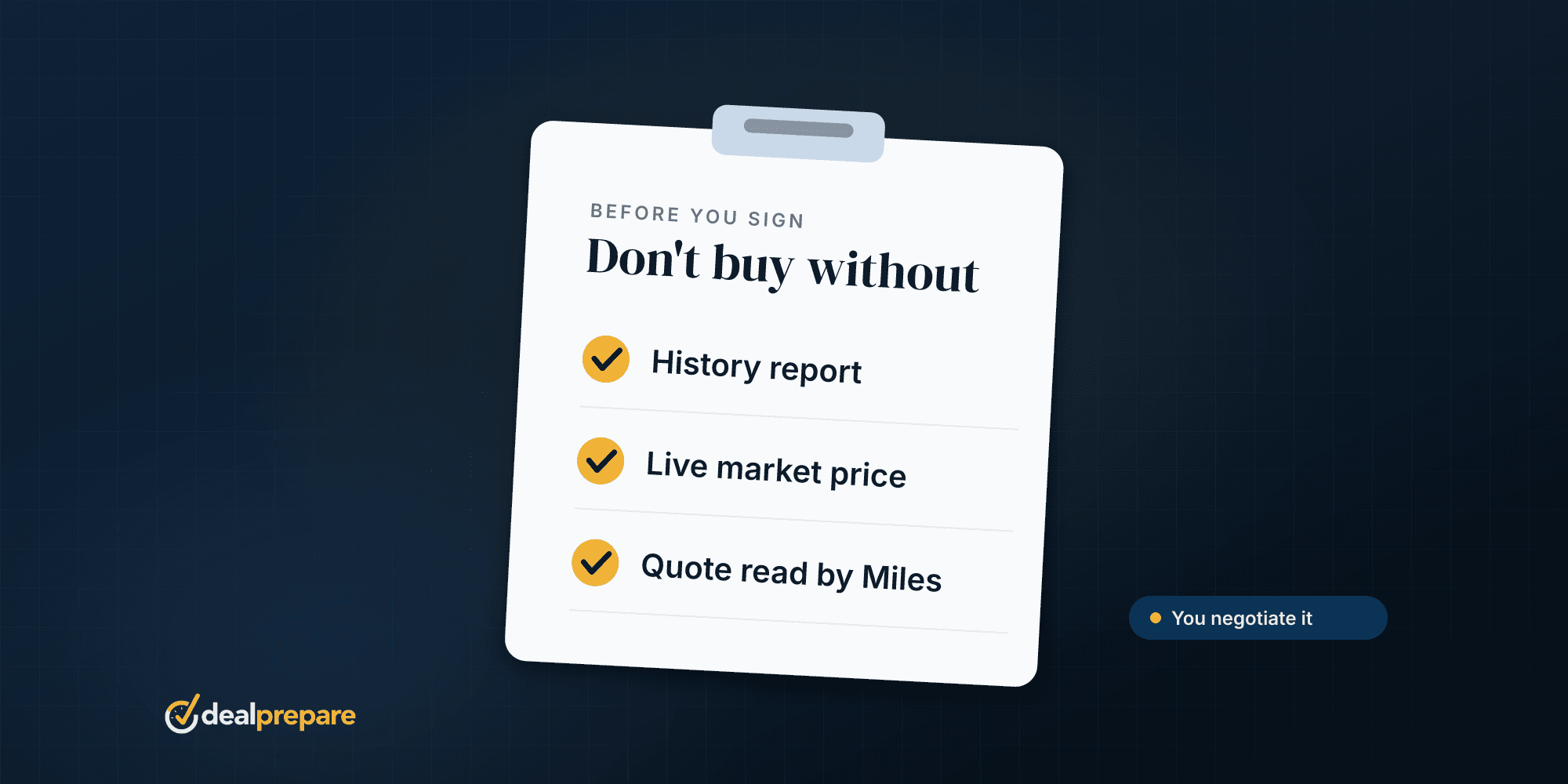
Nobody buys a used car without a vehicle history report anymore. It is the obvious, cheap insurance against a car with a past. A single Carfax report runs about $45.
Knowing the deal is the same kind of insurance, for the other half of the purchase. The history report tells you about the car. Miles tells you about the price, the fees, the add-ons, and the rate.
Here is what it costs:
| What you get | Cost |
|---|---|
| Free market check for any car | Free |
| Prepare with Miles, before you have a quote | Free |
| First quote scan each month | Free |
| Deal Review: one deal, up to six scans of revised quotes | $29 |
| Typical car broker fee | A few hundred dollars to $1,000 or more |
A full Deal Review costs less than one history report. A broker's fee is often ten times that or more.
When a Broker Is Still Worth It
A broker earns the fee when:
- You do not want to talk to a dealer at all. Some people would rather pay than negotiate. That is a fair trade.
- The car is hard to find. Rare trims, allocated models, and specific builds can take real legwork and dealer relationships to source.
- Your time is worth more than the fee. If the hours cost you more than the broker does, the math is simple.
Even then, a second set of eyes on the final numbers is cheap. Scan the broker's deal before you sign it. If it is as good as promised, you will know for sure.
Negotiate Your Own Deal With Confidence
For everyone else, the advantage a broker sells is already within reach. Walk in knowing the typical price for your exact car, the fees your state normally sees, the rate you qualify for, and the out-the-door number you will accept. Ask for it in writing, and be ready to leave. Our negotiation guide covers what to say.
And you do not have to do it entirely alone. If you want a person in your corner, an Expert Review puts a human automotive professional on your deal to check the findings and give personalized guidance. In the Chicago area, an in-person advocate can come to the dealership with you.
Start with the part that is free: check the market price of the car you want.
Frequently asked questions
- Can AI help me buy a car?
- Yes, if it works from real data. AI that searches live listings for your exact car and ZIP, reads the dealer's actual quote, and checks fees and rates against real benchmarks can tell you what a fair deal looks like and what to say. AI that answers from memory is guessing about prices that change every week.
- Should I pay for a car broker?
- Pay for a broker if you do not want to deal with a dealership at all, if you need a hard-to-find vehicle sourced, or if your time is worth more than the fee. If you are willing to have the conversation yourself, knowing the market price, the fair fees, and your real rate gets you most of what a broker delivers for far less.
- How much does a car broker cost?
- Most car brokers charge a flat fee, commonly somewhere between a few hundred dollars and $1,000, and more for luxury or hard-to-find vehicles. Some add a retainer up front or take a share of the savings instead. Ask whether the broker is also paid by the dealer, because that changes whose side they are on.
- Can AI negotiate a car price for me?
- Not at the table. AI will not call the dealer or sign anything for you. What it can do is prepare you: the typical market price with the listings behind it, which fees and add-ons to push back on, the rate you should expect, and the exact words to use. With DealPrepare, a human professional can also review the deal, and in-person help is available in the Chicago area.
- Is a car buying service worth it?
- It depends on what you are paying for. If the value is information, meaning what the car sells for and what a fair quote looks like, that is now available for far less than a broker's fee. If the value is someone else doing the talking and the legwork, that is a real service, and a broker or advocate can be worth it.
Put this advice to work
Upload your dealer quote and Miles will flag the markups, junk fees, and add-ons before you sign anything.
Scan your quote freeNo quote yet? Check the market price free