
Why Dealerships Won't Negotiate Anymore (And What Still Moves)
Dealers say the price is the price. Here is why haggling on the sticker stopped working, where the profit actually moved, and the five numbers on your quote that are still negotiable in 2026.
Miles
Former dealer insider
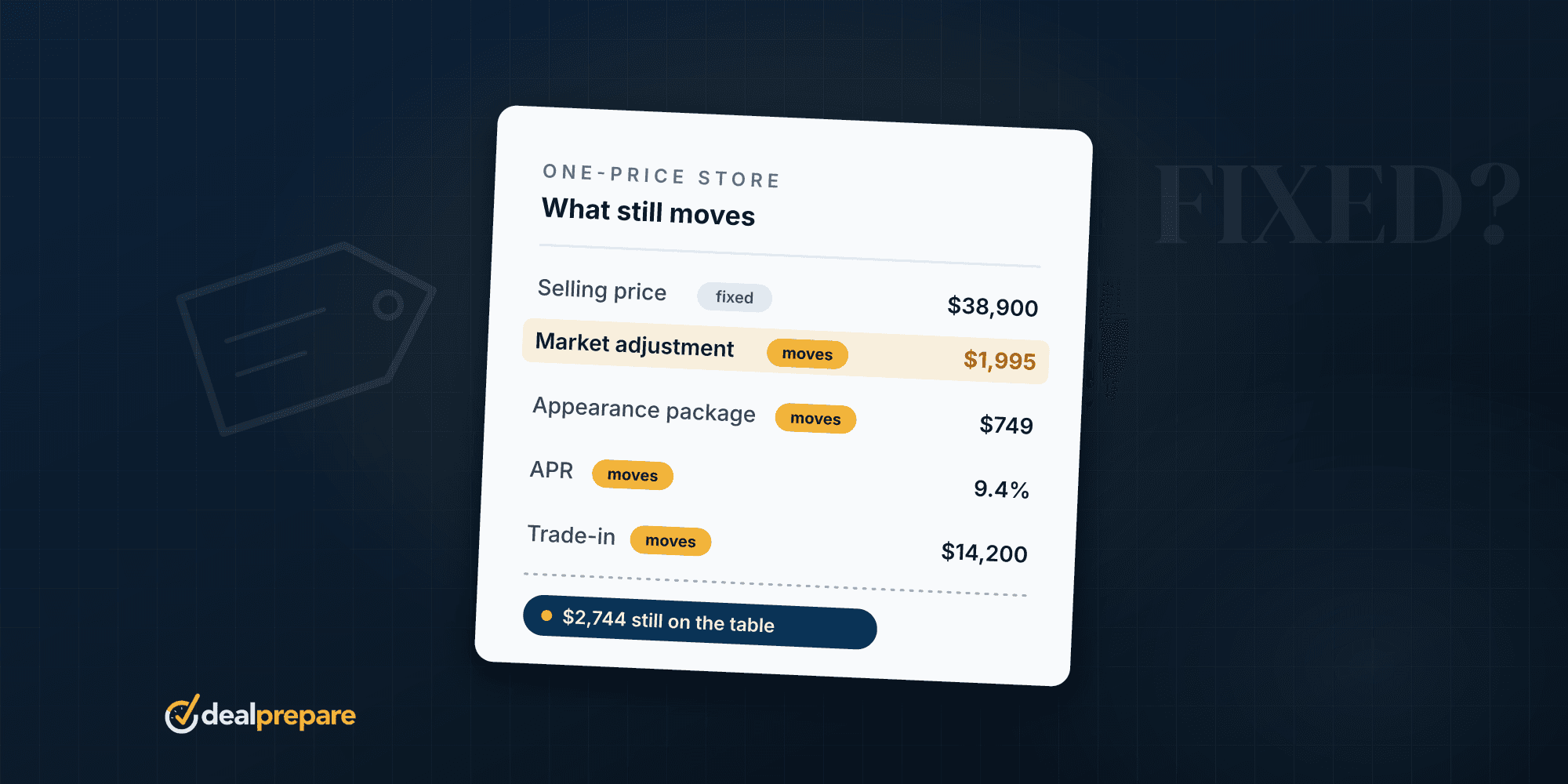
The question shows up in every car buying forum now, in almost the same words: "Why won't any dealership negotiate anymore?" You do the homework, you make a reasonable offer on a car that has been sitting on the lot, and the salesperson shrugs. "That's the price." Sometimes it comes with a line about the three other people who are interested.
Here is the honest answer from someone who sat on the other side of that desk. The price of the car stopped being where dealers make their money, so they stopped defending it. Negotiation did not die. It moved to lines on the quote most buyers never argue about.
Five Reasons the Sticker Stopped Moving
1. The shortage taught dealers a lesson they have not unlearned
From 2021 through 2023, new cars were scarce and buyers paid sticker or above without blinking. Every manager who lived through that period learned that a customer who says "I'll walk" often comes back. Inventory is mostly back in 2026, but a store's habits lag the market by a year or two. The reflex to say "the price is the price" was formed when it was true.
2. One-price stores are now normal, not unusual
CarMax proved that buyers will accept a fixed price in exchange for skipping the back-and-forth, and the large dealer groups copied the model. At a one-price store the salesperson is usually paid on volume and survey scores, not on the profit in each deal. They have no authority to discount and no reason to want to. Asking them for $1,500 off is like asking a cashier for a discount at the register.
3. The internet already negotiated the front end for you
Because shoppers compare prices online in ten seconds, the advertised price on a mainstream car is close to the floor before you ever call. The store has little margin left in that number to give away. That is why the online price looks fair and the out-the-door total comes back thousands higher: the margin was moved to the lines below the price.
4. The profit moved to the back end
Where a dealer makes money on a car deal in 2026:
- Finance office products. Extended service contracts, GAP, and protection packages carry markups that are often 50 to 100 percent over what the dealer pays.
- Finance reserve. The lender approves you at one rate, the dealer presents a higher one and keeps part of the difference.
- Pre-installed accessories. Nitrogen, etching, tint, appearance packages, and "protection" that was applied before the car reached the lot.
- Doc fees. Pure dealer revenue, with averages that run from $85 to $999 depending on the state.
On many new car deals the finance office now produces more gross profit than the sale of the car itself. So "we don't negotiate" means something narrower than it sounds: "we don't negotiate the one number you are looking at."
5. Some cars genuinely have no room
A handful of models sell at sticker with no effort, usually hybrids and trucks on tight allocation. If that is the car you want, the price is probably not moving anywhere in your area, and it is worth knowing that before you spend your leverage arguing about it. The leverage is still there. It is on the other lines.
What Still Moves
| Line on the quote | Does it move? | How |
|---|---|---|
| Advertised price on an in-demand model | Rarely | Compare out-the-door totals by email, wait for days on lot to climb |
| Advertised price on aging inventory | Yes | Cars over 60 to 90 days on the lot, last week of the month or quarter |
| Market adjustment | Almost always | Ask for it removed, or walk |
| Pre-installed add-ons | Yes | Ask for the deal without them |
| Doc fee | Not directly | Most states require the same fee for every customer, so ask for an offset in the price |
| APR | Yes | Bring a pre-approval and make the dealer beat it |
| Trade-in value | Yes | Get an independent offer first and negotiate the trade as a separate number |
| Warranty, GAP, and protection prices | Yes, a lot | Decline in the room, or buy the same coverage elsewhere for less |
How to Negotiate With a Dealer Who "Doesn't Negotiate"
Stop asking for a discount. Ask for the out-the-door price in writing, itemized. A dealer who will not lower the price will usually send this, and it tells you where the money is.
Compare fixed prices against each other. "No haggle" does not mean "the same everywhere." Three stores that all refuse to negotiate can be $1,500 apart once fees and add-ons are counted. The full method is in our negotiation playbook.
Negotiate the sheet, not the sticker. Try this exact sentence: "I'm fine with the price. I need the appearance package and the etching off, and I'd like the doc fee offset in the selling price." A one-price store will often agree, because it does not touch the number they have committed to publicly.
Bring your own money. A pre-approval from a credit union removes the finance reserve from the deal. Here is what a good rate looks like for your credit score.
Use time. The last three days of a month or quarter, and any car that has been on the lot more than two months, are when a "fixed" price gets flexible.
The Market Is Loosening in 2026
Inventory is back for most brands, manufacturer incentives have returned, off-lease vehicles are flooding the used market, and rates have eased from their peak. "We don't negotiate" is a habit from the shortage years, and habits break when a car is 90 days old and the month is ending. Buyers who show up with an out-the-door comparison, a pre-approval, and an outside trade offer are getting real money off again. They are just getting it from different lines than they used to.
Let Miles Find the Lines That Move
This is exactly what a DealPrepare scan does. Upload your quote and Miles separates the number that is probably fixed from the ones that are not: he prices every add-on against what it actually costs, benchmarks the doc fee against your state, compares the APR to your own pre-approval, and gives you the dollar total still on the table, with the words to say for each line.
The dealer decided where the profit lives. You get to decide whether it stays there.
Frequently asked questions
- Are car prices really non-negotiable now?
- The advertised price often is, especially at one-price stores and on high-demand models. The out-the-door price almost never is. Market adjustments, dealer add-ons, the APR, the trade-in value, and the prices of finance office products all move, and together they are usually worth more than the discount you were hoping for on the sticker.
- Is no-haggle pricing actually a good deal?
- Sometimes. A no-haggle price is a competitive price, not necessarily the lowest one. Compare the out-the-door total against two other stores selling the same car. Two stores that both refuse to negotiate can still be $1,500 apart once fees and add-ons are counted.
- Can you negotiate at a one-price dealership like CarMax?
- Not the vehicle price. You can still decline add-ons and protection products, bring your own financing instead of accepting theirs, and get an independent offer on your trade-in. Those three items are where a one-price store makes most of its margin.
- What can you negotiate if the dealer won't move on the price?
- Ask for the deal with all dealer add-ons removed, ask for any market adjustment to come off, bring a pre-approval so the finance rate has to compete, get an outside offer for your trade, and compare out-the-door quotes from other dealers by email. On a typical quote that is $1,000 to $3,000 of movement without touching the sticker.
Put this advice to work
Upload your dealer quote and Miles will flag the markups, junk fees, and add-ons before you sign anything.
Scan your quote free